


Mobile service doesn't fail because of a lack of demand.
It fails because of a lack of ownership.
When a dealership launches mobile, one of the first decisions is also the most important: Who owns it?
In a lot of stores, the answer is unclear. And that's where the problems start.
The Most Common Setup
At most dealerships, mobile service gets handed to:
- The fixed operations manager
- The service director
- The dealership service manager
- Or "the team"
On paper, that's logical. Mobile lives inside the dealership service department, so the service department should run it.
But in practice, mobile almost invariably slips down the priority list.
When the shop is busy, the shop gets the attention. When a tech calls out, the shop gets the attention. When CSI dips, the shop gets the attention.
Mobile becomes the side project. And side projects rarely scale.
Mobile is Operationally Different
Mobile service isn't "the shop, but in a van." It runs on a different set of variables:
- Route efficiency and drive-time labor
- Territory planning and appointment density
- On-site logistics
- Weather disruption
Those aren't traditional service-lane problems. When mobile is managed as an extension of fixed ops, it usually gets measured by the wrong metrics and prioritized behind in-bay production. That caps its growth.
What Strong Programs Do Differently
Dealerships that scale mobile successfully tend to do the same handful of things:
- Assign a dedicated Mobile Service Manager
- Track mobile-specific KPIs
- Set revenue-per-van targets
- Separate mobile scheduling from the service-lane workflow
- Tie incentives to mobile performance
They treat mobile as a business unit, not an overflow channel. That doesn't mean isolating it from fixed operations. It means giving it accountability.
The Software that Makes Ownership Possible
Here's the practical problem: you can't hold someone accountable for numbers they can't see.
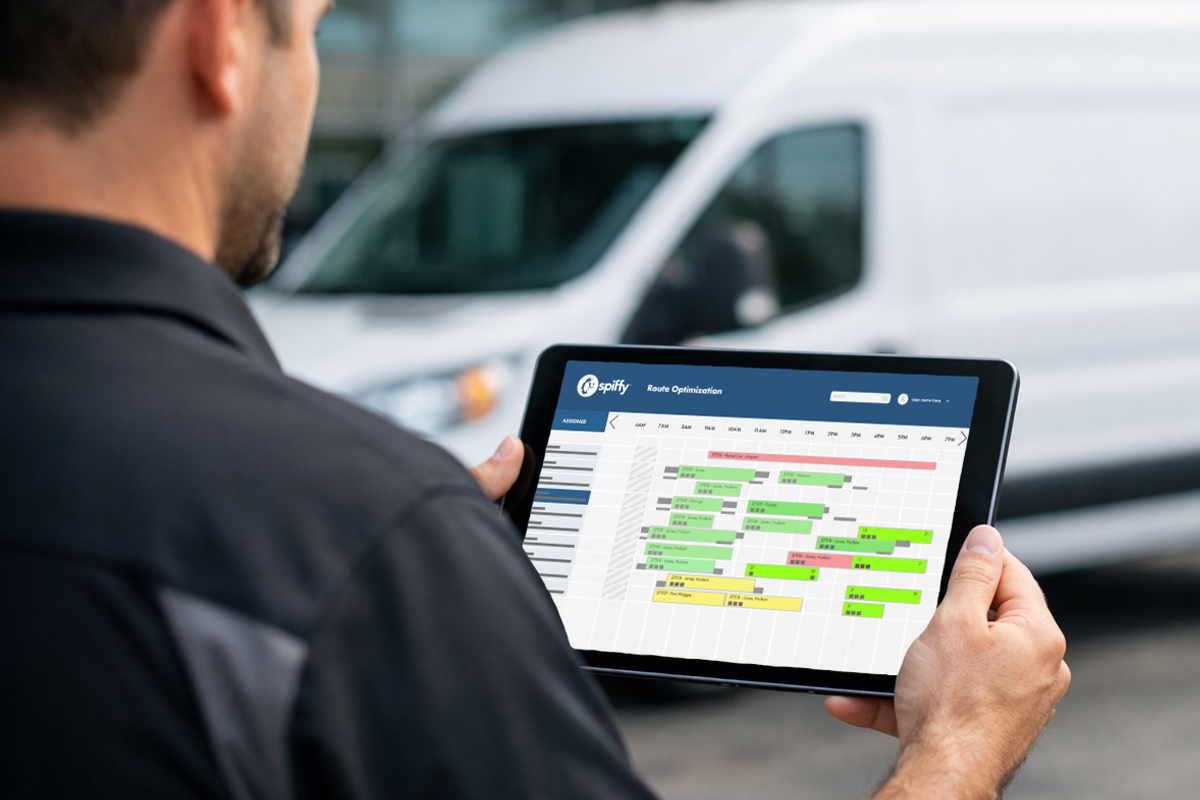
That's where a purpose-built platform matters. Spiffy's Mobile 360™ platform gives a mobile owner the visibility and control the role actually requires:
- Route Optimization: minimize drive time with real-time updates to service routes
- Route Profitability: a detailed P&L view for every route, so you manage margin, not just volume
- Automatic Dispatching: services flow onto technician schedules automatically, without a manager playing air-traffic control
- Reporting & Analytics: the mobile-specific KPIs that in-bay reporting was never built to surface
Give a dedicated owner a system built for mobile, and "who owns it" stops being a question of blame and becomes a question of performance.
Ownership Drives Discipline
When one person is clearly responsible for per-van output, route efficiency, revenue growth, margin, and customer experience, you see cleaner scheduling, smarter routing, more consistent volume, and faster scaling.
Structure drives behavior. And behavior drives results.
The Bigger Risk
The risk isn't that mobile cannibalizes the shop.
The risk is that it underperforms quietly because it lacks focus. When mobile is "everyone's responsibility," it competes internally for attention, and it usually loses to the building.
So Who Should Own It?
There's no single universal answer. But there is a principle: if mobile is expected to grow, it needs a dedicated owner.
That owner should be accountable for performance, understand both operations and economics, have visibility into the metrics, and hold the authority to make scheduling and expansion calls.
Without that, mobile stays a pilot. With it, mobile becomes a growth engine.
The Bottom Line
Mobile service isn't a marketing feature, a convenience add-on, or a side initiative. It's an operating model, and operating models require ownership.
If you want mobile to scale, someone has to wake up every day responsible for making it work. Because in fixed operations, as in any business, structure determines outcome.
Posted in Digital Servicing, Software


